How to choose between two-step method and three-step method in production of thermal break aluminum profile?
How to choose between two-step method and three-step method in production of thermal break aluminum profile?
1. Dilemma of production capacity, cost and profit?
In the production chain of thermal break aluminum profiles, the decision makers of aluminum profile companies are often troubled by these problems:
How to efficiently deliver large-volume orders?
How to control costs in processing complex profiles?
How to ensure profits for small-volume customized orders?
The answer lies in the two core composite processes of “two-step method” and “three-step method”.
As technical choices that directly affect production capacity, cost and quality, how should they match the needs of enterprises?
This article will help you clear the questions and provide a “purchasing decision guide”.
2. Process flow: The game between efficiency and flexibility
Three-step method: The “golden partnership” of mass production and normal products
Process breakdown:
Knurling: The hard rolling gear knurl on the aluminum profiles to enhance the bonding strength of the insulation strip.
Strip feeding: Manual or mechanical insertion of the insulation strip
Rolling: Three sets of rollers are pressed step by step to ensure seamless bonding between the aluminum and the insulation strip.
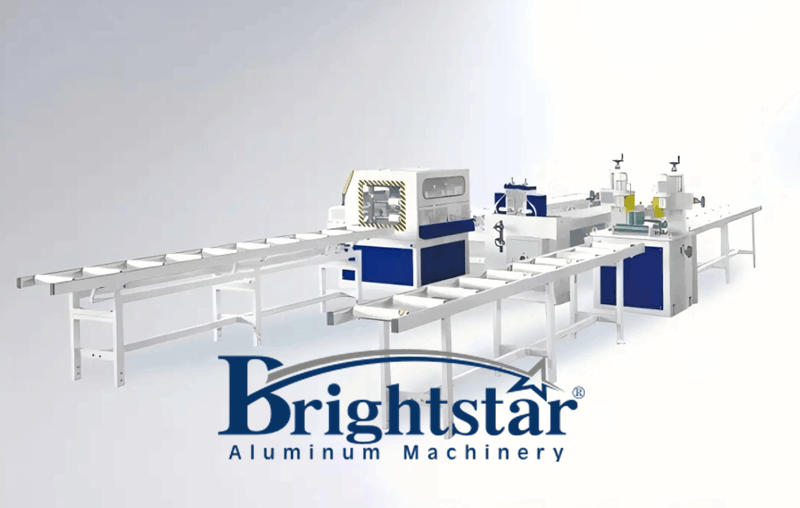
Three step method thermal break aluminum profile making machine
Core advantages:
Flexible adaptation: suitable for narrow groove aluminum profiles such as I-shaped and C-shaped aluminum extrusions.
Step-by-step quality inspection: each process is independently inspected (such as tooth depth and strip insertion accuracy) to reduce the risk of batch scrapping.
Applicable factories:
Aluminum profile factories, door and window factories: batch and normal product production.
Two-step method: The “efficiency engine” of automated production
Process innovation:
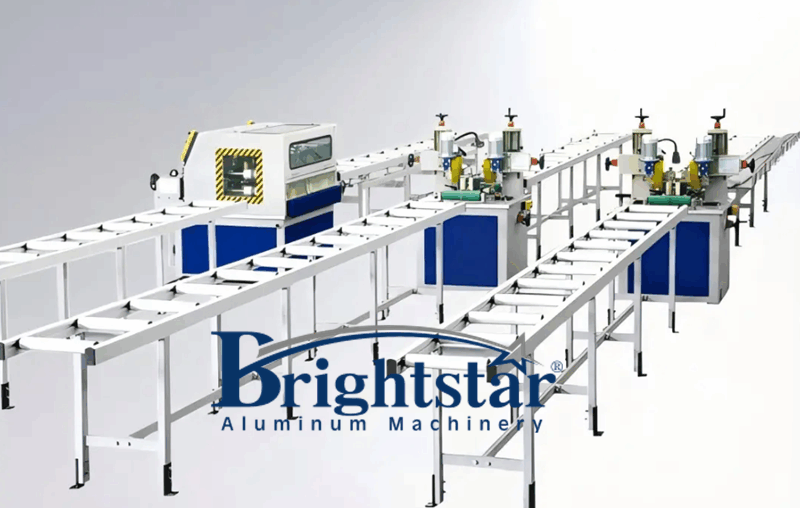
Integrated knurling + strip feeding: A dedicated integrated machine completes the process simultaneously, reducing the time consumption of equipment switching.
Rolling forming: High-speed rolling directly outputs the finished product, completing the tight compounding of aluminum profiles and thermal insulation strips.
Core advantages:
Automated assembly line: suitable for continuous production of standardized profiles (such as casement window general materials), reducing labor dependence by 30%.
Complex sections, large sections and customized processing: All-in-one machine is suitable for large-sized special-shaped profiles (such as curved curtain walls), reducing debugging time.
Applicable factories:
Aluminum profile factory: large-scale engineering orders (such as standardized profiles for real estate projects).
Door and window factory: large-scale, automated production (such as system door and window companies with an annual production capacity of one million square meters).
3. Cost and efficiency: The “key account book” for enterprises to reduce costs and increase efficiency
3.1 Equipment investment comparison
Process type and equipment requirements
| Process | Equipment | Initial cost |
| Three-step method | Knurling machine, strip feeding machine, rolling machine | High |
| Two-step method | Integrated knurling and strip feeding machine, rolling machine | Low |
3.2 Long-term cost and scale benefits
Door and window materials are mass-produced/normal models are produced:
Choose the three-step method: labor costs are controllable and equipment idle loss is low.
Curtain wall materials are more automated/customized production:
Choose the two-step method: the combination of knurling and strip-feeding integrated machine + rolling machine can meet basic production needs, with obvious efficiency advantages
4. Quality control: The “dual logic” of stability
4.1.”Fine control” of the three-step method
Advantages: Step-by-step testing can accurately locate the problem link (such as insufficient knurling depth).
Challenges: Manual threading relies on skilled workers and requires employee training cycles.
4.2.”Automation consistency” of the two-step method
Advantages: Full-process mechanical operation, the product qualification rate is stable at more than 98%.
Risks: Tool wear may cause the knurling to become shallow, and regular sampling is required.
5. Process flow: a game between efficiency and flexibility
Factory portraits that choose the three-step method:
Order characteristics: bulk and normal models.
Factory type: medium and large aluminum profile factories, door and window factories.
Core capabilities: experienced technical workers who can cope with complex process adjustments.
Factory portraits that choose the two-step method:
Order characteristics: customization, standardization, high proportion of special profiles (such as common window types for real estate projects).
Factory type: large aluminum profile factory, large-scale customized system door and window enterprise.
Core capabilities: experience in automated production line management, complete equipment maintenance team.
Conclusion
There is no absolute “best” process—only the most appropriate one for the specific application.
Whether adopting the meticulous craftsmanship of the “three-step method” or the streamlined efficiency of the “two-step method,” both approaches fundamentally represent a balance between technological capability and cost efficiency.
Manufacturers should make flexible selections based on product specifications and performance requirements.
When producing and processing thermal break aluminum profiles, it is worth considering: Which process offers the optimal balance for this application?
This question may hold the key to differentiating product quality while maintaining cost control.
More Information I Want To Know
 How do I make thermal break aluminum profile?
- Multi aluminium billets cutting saw system
- Aluminium liquid refining degassing machine in the fair
- Main factors that affect electrostatic powder coating
- Part six: peeling, Aluminum extrusion defect analysis and quality control method
- Aluminium dross processing machine from China