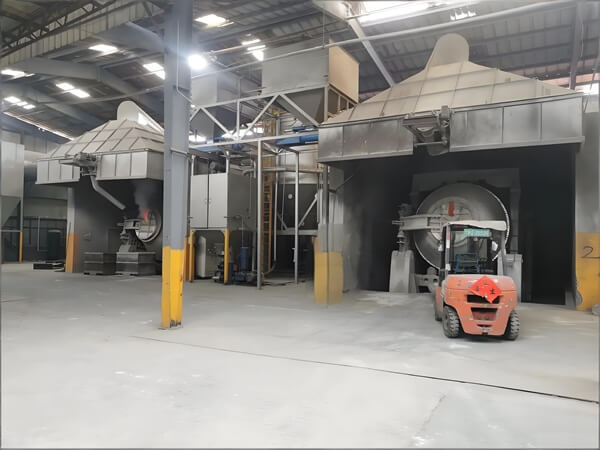
How to improve production efficiency of calcining furnace for aluminum dross?
How to improve production efficiency of calcining furnace for aluminum dross?
1. Aluminum dross calcination process
The aluminum dross calcination process is a method of converting aluminum dross into reusable aluminum material through high-temperature treatment.
Aluminum dross refers to the waste residue generated during aluminum production, which contains a certain proportion of aluminum metal and alumina.
Through calcination, the useful components in the aluminum dross can be extracted, achieving the goal of resource utilization.
2.Principle of Aluminum dross calcination process
Aluminum dross is mainly composed of alumina and aluminum metal, with alumina being the primary component.
The principle of the calcination process is to reduce alumina to aluminum metal through a chemical reaction at high temperatures, while converting other impurities and oxides into gases or residues, thereby achieving the resource utilization of aluminum dross.
The calcination process is usually carried out at high temperatures, with common calcination temperatures ranging from 800℃ to 1100℃.
Aluminum dross calcination is an important waste treatment and resource recycling technology.
It can transform waste aluminum dross into usable resources, achieving resource recycling.
Aluminum dross calcination has broad application prospects in aluminum smelting, building materials, environmental protection, and metallurgy.
Through continuous improvement and innovation, aluminum dross calcination will make a greater contribution to industrial development and environmental protection.
So, how can production efficiency of aluminum dross calcination furnace be improved?
3.To improve production efficiency of calcining furnace, the following aspects can be considered:
3.1 Equipment Optimization
3.1.1 Upgrade the Combustion System
Select appropriate burners to ensure complete fuel combustion and improve energy efficiency.
For example, the gas burners used can achieve a combustion efficiency of over 95%, significantly reducing fuel consumption compared to traditional burners.
Optimize the combustion air supply system to ensure an appropriate air-to-fuel ratio.
Install air flow sensors and automatic regulating valves to monitor and adjust the air supply in real time for optimal combustion performance.
3.1.2 Improve Furnace Structure
Utilize appropriate insulation materials to reduce heat loss from the furnace.
For example, using high-temperature resistant, low-thermal-conductivity ceramic fiber insulation materials can effectively reduce the outer wall temperature of the furnace, decrease heat loss, and improve energy efficiency.
Optimize furnace design to improve the uniformity of material heating.
For example, employing a rotary furnace body or multi-layer hearth design allows materials to tumble and mix thoroughly within the furnace, ensuring uniform heating of all parts of the material, thereby improving calcination effect and efficiency.
3.1.3 Install Residual Heat Recovery Devices
Install waste heat recovery devices, such as waste heat boilers or air preheaters, on the flue gas ducts of the calcining furnace to recover waste heat from the flue gas.
This heat can be used to preheat combustion air, heat water, or generate steam, thereby reducing energy consumption.
The heat recovery efficiency of waste heat recovery devices can reach over 30%, significantly reducing production costs.
3.2 Operation Management
3.2.1 Reasonable Control of Material Input and Output
Precisely control the material feed rate and speed to ensure an appropriate filling rate in the furnace.
Excessive feed will lead to material accumulation, affecting heat transfer and calcination efficiency; insufficient feed will reduce furnace utilization and increase energy consumption per unit product.
Optimize discharge time and method to avoid material accumulation due to untimely discharge or temperature fluctuations caused by excessively rapid discharge.
An automatic discharge device can be used to automatically control the discharge time and speed based on the calcination status of the material in the furnace and the production progress.
3.2.2. Strictly Control Calcination Temperature and Time
Based on different material characteristics and calcination requirements, develop reasonable calcination temperature and time curves.
Through a precise temperature control system, such as intelligent temperature controllers and thermocouples, monitor the furnace temperature in real time and adjust the burner power and air supply promptly to ensure the furnace temperature remains stable within the optimal calcination range.
Avoid over-calcination or under-calcination to improve product quality and energy efficiency.
Over-calcination leads to decreased material performance and energy waste, while under-calcination affects product quality.
Regular sampling analysis and adjustment of calcination parameters ensure that the material is fully and appropriately calcined.
3.2.3. Strengthen Equipment Maintenance and Upkeep
Establish a comprehensive equipment maintenance system, and regularly inspect, clean, and repair the calcining furnace.
This includes cleaning accumulated ash and slag inside the furnace, checking the furnace’s sealing and insulation performance, and maintaining the normal operation of the combustion and control systems.
Replace worn parts promptly, such as burner nozzles and furnace refractory materials, to ensure equipment performance and efficiency.
Regular inspections and maintenance can extend the equipment’s service life, improve its reliability and stability, thereby ensuring continuous production and increased efficiency.
3.3 Process Optimization
3.3.1 Optimize Material Pretreatment
Appropriate pretreatment of materials, such as crushing, screening, and drying, improves their uniformity and permeability, which is beneficial for heat transfer and calcination reactions.
For example, crushing materials to a suitable particle size range increases their specific surface area and improves calcination efficiency
Drying materials reduces their moisture content and decreases energy consumption during calcination.
3.3.2 Calcination Processes Employed
Explore and apply new calcination processes, such as microwave calcination and plasma calcination.
These processes offer advantages such as rapid heating, high energy efficiency, and good product quality, significantly improving the efficiency of the calcining furnace.
Combine different calcination processes for combined calcination.
For example, employing a two-stage calcination process with preheating followed by calcination, or a composite process combining calcination with reduction, oxidation, or other processes, can fully leverage the advantages of each process and improve calcination effectiveness and efficiency.
3.3.3 Achieve Automated Control
The automated control system employs real-time monitoring and automatic adjustment of the calcining furnace operation.
For example, through a PLC control system and sensor network, automatic control of parameters such as furnace temperature, furnace pressure, and material flow rate is achieved, improving production stability and consistency, and reducing errors and labor intensity from manual operation.
A remote monitoring and management system is established to achieve centralized management and optimized scheduling of multiple calcining furnaces.
Through internet technology and big data analysis, the operating status and production progress of the equipment are monitored in real time, allowing for timely identification and resolution of problems, and improving the overall efficiency of equipment utilization.
4. The steps of aluminum dross calcination process:
The aluminum dross calcination process typically includes the following steps:
Pretreatment: Before calcination, the aluminum dross needs to be pretreated.
The purpose of pretreatment is to remove impurities from the aluminum dross, making its composition purer.
Pretreatment methods can include ball mill and screening, Raymond mill, etc., to separate impurities from the aluminum dross.
Calcination: The pretreated aluminum dross enters the calcination furnace for further processing.
The calcination furnace is a high-temperature environment that provides sufficient heat to reduce the alumina in the aluminum dross to aluminum metal.
The temperature and atmosphere conditions in the calcination furnace need to be adjusted according to the specific aluminum ash composition and calcination requirements.
Cooling: After calcination, the aluminum metal in the aluminum dross will exist in powder or block form.
To facilitate subsequent processing and utilization, the aluminum dross needs to be cooled.
Cooling methods will be done with aluminum dross cooler.
Sorting and Recycling: After cooling, the aluminum metal and other impurities in the aluminum dross can be separated by physical or chemical methods.
Common sorting methods include magnetic separation, gravity separation, and flotation.
Sorted aluminum can be reused, while other impurities require further processing or disposal.
5. Applications of Aluminum Dross Calcination Process
The aluminum dross calcination process has wide applications in the aluminum industry.
Through calcination, waste aluminum dross can be converted into reusable aluminum materials, achieving resource recycling.
Simultaneously, the gases generated during calcination can be treated, reducing environmental pollution. The aluminum dross calcination process can also be applied to other fields.
For example, in the building materials industry, aluminum dross can be used as a raw material for manufacturing lightweight concrete or cement, bricks and ceramic and porcelain slab, etc.
In the electronics industry, aluminum dross can be used as a raw material for electronic components;
In the steel industry, aluminum dross can be used as raw material for steel making agent or deoxidizer;
In the chemical industry, aluminum dross can be used as a raw material for catalysts and water purifier, etc.
The wide application of the aluminum dross calcination process is of great significance for improving resource utilization efficiency and reducing environmental pollution.
6. Conclusion
Aluminum dross calcination is a process that transforms aluminum dross into reusable aluminum materials.
Through calcination, the alumina in the aluminum dross is reduced to aluminum metal, while other impurities are converted into gases or residues.
The aluminum dross calcination process includes pretreatment, calcination, cooling, and sorting steps.
This process is widely used in the aluminum industry and other fields, enabling the resource utilization of waste aluminum dross, improving resource utilization efficiency, and reducing environmental pollution.
Reference:
[1] 杨群,李祺,张国范,等. 铝灰综合利用现状研究与展望[J]. 轻金属,2019(6):1-5.
YANG Q, LI Q, ZHANG G F, et al. Research and prospect of the status of comprehensive utilization of aluminum dross[J]. Light Metals,2019(6):1-5.
[2] 贺永东,李颜凌,马斌,等.湿法工艺对二次铝灰无害化脱氮的影响[J].特种铸造及有色合金,2021,41(06):679-683.
HE Y D, LI Y L, MA B, et al. Effects of wet process on harmless nitrogen removal from secondary Al dross[J].Special Casting Nonferrous Alloys,2021,41(06):679-683.
[3] 谢明壮,单迪,韩金珊,等. 铝灰中有害元素脱除及钙化转相制备铝酸钙[J].中国冶金,2023,33(06):115-121.
XIE M Z, SHAN D, HAN J S, et al. Removal of harmful elements from aluminum dross and preparation of calcium aluminate by calcium conversion[J].China Metallurgy,2023,33(06):115-121.
[4] 柏阳,赵志强,陈福新,等. 利用二次铝灰钙化焙烧合成铝酸钙过程基础研究[J].轻金属,2023,(10):12-18.
BAI Y, ZHAO Z Q, CHEN F X, et al. Basic research on the process of synthesizing calcium aluminate using secondary aluminum dross calcification and baking[J].Light Metals,2023,2023,(10):12-18.
[5] 张宇,李勇,李春雷,等. 二次铝灰中氮化铝的特性及其脱除工艺研究进展[J].矿产保护与利用,2021,41(02):144-149.
ZHANG Y, LI Y, LI C L, et al. Characteristics and removal process of aluminum nitride in secondary aluminum dross: a review[J].Conservation and Utilization of Mineral Resources,2021,41(02):144-149.
[6] 韩金珊,左正平,赵洪亮,等. 二次铝灰处置及利用现状及其在炼钢中的应用[J].中国冶金,2022,32(05):16-24.
HAN J S, ZUO Z P, ZHAO H L, et al. Disposal and utilization of secondary aluminum dross and its application in steelmaking[J].China Metallurgy,2022,32(05):16-24.
More Information I Want To Know
 How to Make Aluminum Dross Reduction, Utilization and Harmless Treatment
- How to reduce energy consumption in aluminum dross utilization process
- Research on aluminum dross processing and hazardous waste utilization
- Innovative Aluminum Melting Technologies for Energy saving, environmental sustainability, cost reduction and efficiency improvement
- Introduction of aluminum compound products that can be produced from aluminum dross
- Aluminum Dross Recovery Machine: Essential for Smelters